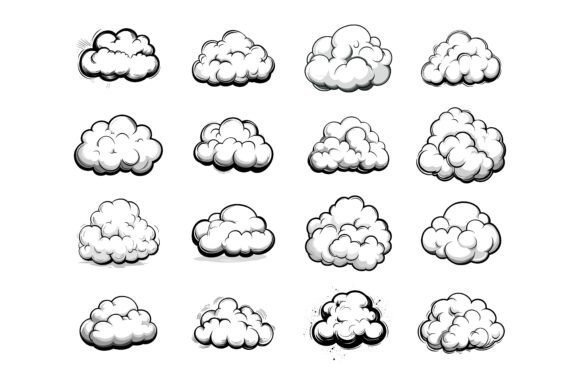
Vector Cloud on White Background: What Most People Overlook Before Downloading
You found a clean, modern vector cloud on white background and it looks exactly like what your project needs. But before you hit download or make a purchase, there are a few things worth pausing to consider. Many people rush into grabbing the first cloud vector they see, only to discover later that the file does not work the way they expected. The illustration might be beautiful, but if the structure, format, or editability falls short, you end up wasting time fixing problems instead of moving your work forward.
Understanding what makes a vector cloud illustration truly usable can save you from those frustrating moments. Whether you are designing a website hero section, building an app interface, putting together an infographic, or preparing print materials, the right file setup matters. This article walks through the practical side of choosing and using cloud vectors, with a focus on what experienced designers and creators check before committing.
Why a Vector Cloud on White Background Is More Versatile Than It Looks
A cloud graphic on its own seems simple. But when it is built as a vector on a clean white background, it becomes a flexible asset that can shift across dozens of use cases. You can drop it into a presentation slide without worrying about clashing colors. You can scale it up for a large banner without losing sharpness. You can change the cloud from white to blue, add a gradient, or adjust the stroke weight to match your brand style.
The white background also matters more than people think. Some files advertised as having a white background actually include a flattened white rectangle behind the cloud, which limits how you can layer the graphic. A properly constructed vector cloud on a transparent or easily removable white layer gives you full control. This is especially important if you plan to place the cloud over colored sections, photographs, or textured backgrounds later.
Common Mistakes When Selecting Cloud Vector Files
Even with a straightforward subject like a cloud, the way the file is prepared can make or break your workflow. Here are some of the most frequent oversights people encounter.
Assuming All File Formats Are Equally Editable
One of the biggest misunderstandings is treating every download as if it offers the same editing freedom. A JPG version of a cloud on white background is fine for quick placement, but you cannot easily recolor it, remove the background cleanly, or resize it without quality loss. The AI and EPS formats are where real flexibility lives. These allow you to open the illustration in Adobe Illustrator or compatible software and access individual layers, paths, and colors.
If you only receive a flattened image when you expected an editable vector, your project stalls. You might need to recreate elements from scratch or pay someone else to do it. Checking the file list before purchasing, and confirming that AI and EPS formats are included, helps you avoid this situation entirely.
Overlooking Layer Organization and File Structure
A vector file can be technically editable but still a nightmare to work with if it was not built with care. Some cloud illustrations arrive with hundreds of ungrouped paths, no labeled layers, and elements scattered across the canvas. When you try to isolate just the cloud shape or adjust a specific shadow, you waste minutes or even hours hunting through the file.
Well-organized vectors use clearly named layers and logical grouping. The cloud might sit on one layer, the background on another, and any accent details on a third. This structure means you can turn elements on and off, recolor specific parts, or export variations without dismantling the entire illustration. It is a detail that separates a professionally prepared asset from something that only looks good in a preview.
Ignoring Consistency Across a Set
When you buy a collection of cloud illustrations, consistency in style, line weight, and level of detail matters. If one cloud uses thin strokes and flat colors while another in the same set has thick outlines and heavy gradients, the mismatch shows up immediately when you place them together in a design. This often happens with bundled sets pulled from multiple sources without a unifying quality check.
Before purchasing, look at the preview images carefully. Do the clouds share a common visual language? Is the level of polish even across the set? A consistent collection means you can mix and match illustrations without your audience noticing jarring differences. It also signals that the creator paid attention to detail throughout the entire production process.
Forgetting to Check Cross-Platform Compatibility
Many designers work on Mac, but their collaborators or clients use Windows. Others switch between systems themselves. Vector files should open and function correctly on both platforms, but not all files are tested equally. Fonts embedded in EPS files, for example, can cause issues if the receiving system does not have the same typefaces installed. Color profiles can shift between operating systems if not handled properly.
Files specifically designed and tested for both Mac and Windows users reduce these headaches. You can share the assets with confidence, knowing that what you see on your screen is what your colleague or printer will see on theirs.
How Poor File Choices Affect Your Results
The consequences of choosing the wrong cloud vector ripple through your project in ways that are not always obvious at first. A file that cannot be properly recolored might force you to compromise your brand palette. An illustration that loses detail when scaled down could make your app icon look blurry or unprofessional. A poorly structured file might double your production time because you spend more effort fixing it than using it.
For print projects, the stakes are even higher. A low-resolution JPG stretched to fit a poster creates visible pixelation that no amount of last-minute adjustment can fix. Vector formats like AI and EPS prevent this entirely because they are resolution-independent. You can output at any size, from a tiny sticker to a large trade show graphic, without ever worrying about jagged edges.
There is also the matter of presentation quality. When you deliver work to a client or share a proposal with stakeholders, the crispness and professionalism of your visuals shape their perception of you. A cloud illustration that looks handcrafted and precise signals care. One that appears slightly off, with inconsistent curves or accidental color artifacts, can undermine trust in your overall work.
Practical Advice for Getting the Most from Your Cloud Illustrations
The good news is that avoiding these problems comes down to a few simple habits. First, make it a practice to read the file format list before any purchase or download. Look specifically for AI and EPS alongside any JPG previews. The JPG is useful for quick reference, but the vector formats are what you will actually build with.
Second, take a moment to inspect the preview carefully. Zoom in if the platform allows it. Check whether the edges are smooth, the curves are clean, and the level of detail matches what your project requires. A cloud that looks perfect at thumbnail size might reveal rough anchor points or uneven spacing when viewed larger.
Third, consider how the illustration fits into your broader workflow. If you frequently customize graphics, prioritize files that are built with editing in mind. A collection that advertises ease of color changes, organized layers, and clean structure is speaking directly to professionals who value efficiency. The difference between a file you can modify in two minutes and one that takes twenty adds up quickly across multiple projects.
Applying Cloud Vectors Across Different Mediums
A well-made vector cloud on white background adapts to many contexts. For web design, you can use it as a hero image element, a section divider, or a subtle background texture. The white background can be removed or kept depending on your layout needs. For infographics, cloud icons can represent data categories, weather concepts, or cloud computing topics without distracting from the information.
In app and symbol design, consistency becomes even more critical. Interfaces often use small icon versions of illustrations, and a cloud that retains its clarity at tiny sizes is worth holding onto. Print designers benefit from the same precision, whether the cloud appears on a business card, a brochure cover, or packaging.
What to Check Before Making a Decision
Before you buy or download a cloud vector set, run through a short mental checklist. Does the product description mention AI and EPS formats specifically? Are Mac and Windows users both supported? Is there language about organized layers, file structure, or ease of editing? Do the preview images show consistency across the collection? Can you realistically see yourself using these illustrations in your actual projects, not just admiring them in isolation?
These questions take seconds to answer but can steer you away from files that look promising in a shop preview but fail under real working conditions. If the description uses phrases like "neatly organized file and layer structure" or "perfection in details and consistency," that is a positive signal. It suggests the creator understands what matters to people who will actually use the product, not just browse it.
The same goes for specific use case mentions. When a collection is described as suitable for print, web, symbols, apps, and infographics, it indicates versatility that has been thought through and tested. You are not getting a one-note graphic that only works in a narrow scenario. You are getting an asset that can grow with your needs.
Making the Most of Your Purchase
Once you have a quality vector cloud set in hand, the real creative work begins. Open the AI or EPS file and explore the layers before making changes. This quick orientation saves you from accidentally editing the wrong element. Try out a few color variations to see how the cloud adapts. Check how it looks at different sizes, both on screen and in a test print if applicable.
Keep the original file untouched and work on a duplicate. This way, you always have a clean source to return to if an edit goes too far or if you need a fresh version for a different project. Simple habits like this extend the useful life of your purchase and make your workflow smoother.
Cloud illustrations on white backgrounds remain one of the most broadly useful graphic assets available. They fit into corporate presentations, creative projects, educational materials, and commercial designs with equal ease. The key is choosing versions that are built to be used, not just viewed. When the file structure is solid, the format support is comprehensive, and the details are consistent, a simple cloud vector becomes a reliable tool you return to again and again.