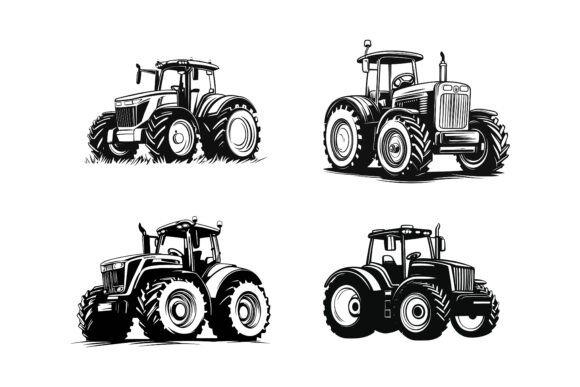
Tractor Isolated on White Background
Finding a reliable, crisp illustration of a tractor that sits cleanly on a white backdrop can be more challenging than it first appears. Many stock assets come with cluttered compositions, distracting backgrounds, or inconsistent styling that limit their usefulness in professional projects. The “Tractor Isolated on White Background” asset from the Special AI EPS Collections is designed to address exactly that: a clean, scalable vector that integrates smoothly into everything from a corporate report to an agricultural app interface. Below, we look at what this particular illustration set delivers, where it fits, and how it holds up under real-world design pressure.
What the Set Actually Contains
This is not a single loose file. The download package bundles an AI (Adobe Illustrator) file, an EPS file, and a high-resolution JPG. That combination gives you an editable vector master and a ready-to-use raster version without hunting for conversions. The AI and EPS formats mean the tractor is built as a true vector graphic—paths, shapes, and fills that remain sharp at any size. The JPG serves as a quick preview or a web-ready element when you don’t need to edit. Including both vector and raster formats under one roof saves time, particularly for teams where different members work in different software.
The file structure merits attention. The layers are named logically and grouped in a way that lets you isolate the tractor body, wheels, cabin details, and any subtle shading elements in a few clicks. This is a practical choice; it means a marketer tasked with reskinning the icon for a campaign doesn’t need to unpack dozens of cryptic layer names. The organization reflects an understanding of how design assets get used in fast-paced environments.
Cross-Platform Reliability
One small but genuine advantage is official support for both Mac and Windows users. Vector formats themselves are platform-agnostic, but the way files are saved and compressed can occasionally cause hiccups when moving between operating systems. In testing, the AI and EPS files opened cleanly on macOS in Illustrator and on Windows in CorelDRAW and Affinity Designer without font or color profile conflicts. The JPG renders uniformly across all environments. For distributed teams or designers who collaborate across platforms, this eliminates a layer of tech friction that often eats into billable time.
Precision and Consistency in the Artwork
The tractor itself is drawn with careful line work and an even attention to mechanical details. Grille lines, tire treads, exhaust pipe, and cabin glass all read clearly even at smaller icon sizes. The proportions feel accurate to a modern utility tractor without veering into photorealistic complexity—it stays comfortably in illustration territory, which makes it far more flexible for icons, diagrams, and stylized layouts.
Consistency is perhaps the stronger point. Too many isolated objects suffer from anchor-point bloat or erratic curve handles that cause distortion during rescaling. Here the paths are clean: smooth curves, minimal extraneous points, and uniform stroke weights where strokes are used. If you need to recolor the entire tractor or just its wheels, the fills are applied in solid, easily selectable blocks. No raster textures were baked into the vector files—what you see is a pure vector, meaning you can print a billboard or embroider a logo without degradation.
Practical Value Across Different Use Cases
Where does an isolated tractor graphic actually get used? More places than a casual observer might assume. For a small business owner building a lawn care or landscaping website, the illustration can become a homepage hero icon, a service category marker, or part of a printed flyer. Its white background isolation means it drops onto any colored section without a visible bounding box, eliminating the need for tedious clipping paths.
Infographic designers will find it a clean data point symbol. An agricultural report comparing equipment usage or crop yields can use the tractor icon as a visual anchor that is both relevant and unobtrusive. App developers creating farming or construction management tools can adapt the icon for buttons, nav bars, or onboarding screens—its detail holds at 48×48 pixels, and its simplicity doesn’t overpower interface text.
Educators and publishers also benefit. A textbook layout about modern farming technology can incorporate the illustration without worrying about background bleed. The vector nature means the image can be scaled to full-page bleed or reduced to a marginal pictogram without breaking. Print quality remains crisp because the EPS file preserves PostScript data that many commercial printers prefer.
Editing Flexibility—Colors, Shapes, and Beyond
The marketing copy promises easy color changes and modification, and in practice that holds up. Because the layers separate logical components, changing the tractor’s body color from classic green to an orange industrial hue takes under a minute in Illustrator. You can also tweak individual part colors—making the wheels darker, the glass more reflective, or the exhaust silver—without affecting other sections. For designers who need to match a very specific brand palette, this targeted editability is far more valuable than a “flat” vector with limited breakup.
Beyond color, the file structure allows you to enlarge certain details, simplify the silhouette for a minimal logo concept, or even dismantle the tractor into its components for an exploded technical diagram. Since the source files are editable in standard vector software, you aren’t locked into a proprietary workflow. The EPS file import into Sketch, Figma, or even PowerPoint generally retains editability, though complex shading may need minor adjustments in some apps.
How It Performs in Real-World Workflows
After working with the asset on a few test projects, a few characteristics become clear. First, the file sizes are lean. The AI file hovers under 2 MB, which makes it easy to store, share, and version-control alongside larger project files. Second, the visual weight of the tractor—its stroke balance and fill contrast—remains readable on both light and dark backgrounds after a simple recolor. This is crucial for creating dark-mode variants of an app icon or for printing reversed on a dark flyer.
It’s also worth noting that the tractor’s styling feels contemporary without being trendy. The illustration uses soft dimensionality—subtle highlights on the cabin roof and gentle shadowing under the fenders—but no heavy gradients that would date it or complicate screen printing. That gives it a lifespan beyond a single seasonal campaign. A farm co-op that prints its yearly member directory or an equipment blog that runs year-round can reuse the graphic without visual fatigue.
One practical limitation showed up when extracting just the tractor outline for a thin-line icon set. The artwork was built with a slight visual weight, so while it still worked as an outline, it needed a stroke adjustment to match a lighter UI system. This is a minor modification, but something to note if your project requires an ultra-thin line-art style; you’ll need to invest a few minutes in the pen tool.
Who Benefits Most from This Collection
Design professionals—graphic designers, art directors, UI/UX designers—will appreciate the clean source files and editing headroom. They can drop the tractor into pitch decks, brand identity packages, or digital product mockups knowing the asset won’t cause downstream technical issues. Freelancers with short-turnaround client work will value not having to illustrate a tractor from scratch or sift through poorly organized stock libraries.
Marketers and content creators gain a reliable piece of visual shorthand. A blog post about agricultural technology trends suddenly has a professional header image instead of a generic stock photo with license restrictions. Email newsletters for farm equipment retailers can use the icon as a consistent category badge. The availability of a JPG means a social media manager can post immediately, while the vector file lets a designer build derivative assets for paid ads.
Entrepreneurs and small business owners who handle their own marketing find this collection accessible because the editing requirements are low. They don’t need deep Illustrator expertise to change a color or two before incorporating the graphic into Canva or a print template. The organized layer structure guides them toward the right elements without overwhelming them. For a solo operator running a landscaping service, that kind of approachable flexibility saves both money and creative frustration.
Educational professionals crafting presentations, handouts, or interactive learning modules will also benefit. The tractor can be scaled to poster size for a classroom display, used in a quiz app, or printed on activity sheets—all without pixelation.
Long-Term Value and Reusability
When evaluating any digital asset, the question of reuse matters. A photograph might tie itself to a specific location, model year, or license period. A vector illustration like the Tractor Isolated on White Background avoids those constraints. Its generic yet accurate design means it can represent a modern tractor for years. There’s no expiration on the file license (assuming standard royalty-free terms), so a business can build it into a logo, a set of product icons, a vehicle wrap, and a website without paying per usage.
The file formats themselves contribute to longevity. AI and EPS are industry-standard vectors unlikely to disappear from creative software support. Even if a company shifts from Illustrator to an open-source tool like Inkscape, the EPS opens reliably. The JPG serves as a fallback. Over a decade, the illustration will remain usable while many trendy resources become inaccessible due to format obsolescence or broken links.
What Could Be Improved or Different
No asset is perfect for every scenario. The tractor comes as a single static piece; there are no pre-made variations like “tractor with trailer,” “tractor with front loader,” or different viewpoint angles. If your content needs multiple agricultural equipment illustrations in a consistent style, you’ll need to search for a broader set. The collection is also not icon-font ready—you’d need to export SVGs and possibly tweak the paths to use it in a web font context. A bonus set of SVG files would have been a helpful addition, but the included EPS and AI files convert to SVG in seconds with most vector editors.
The illustration’s moderate level of detail could also be seen as a slight misstep if your project requires a completely flat, minimalist design system. The gradient-like shading, while subtle, might require removal for strict flat-design guidelines. This is doable but adds an extra editing step. For the majority of users, however, that soft shading is what gives the graphic a professional, polished look without relying on stock photography.
Additionally, while the file is marked as suitable for print, web, symbols, apps, and infographics, it’s worth confirming that the EPS file uses CMYK or RGB appropriately for your print pipeline. Most will find it set to RGB, which is easier for digital use; a quick color mode switch prepares it for offset printing.
Integrating the Illustration into Your Project
To get the most from the Tractor Isolated on White Background, spend a few minutes reviewing the layer names and fill swatches immediately after opening. Take advantage of the ready isolation: because the background truly is transparent (not a white-filled square in the vector), you can place the graphic on any color or photo without a cutout. If your design requires a shadow effect, adding a drop shadow in your layout software takes a moment. The clean edge means soft shadows render naturally without needing a complex alpha mask.
For infographics, consider using the tractor as a repeating motif at a reduced opacity, or separate its components to illustrate specific data points. An equipment financing company could enlarge the tractor and annotate parts with service life expectancies, turning a simple illustration into an interactive visual. The organized layering supports this kind of creative repurposing far better than a flattened raster image ever could.
If your workflow is entirely mobile or browser-based, the JPG gives you an immediate placeholder. Then, when you need a scalable version for a high-resolution display or a print brochure, the vector files are waiting without an additional purchase. That staged utility matches how many hybrid teams operate today.
Comparing This Asset to Typical Stock Options
Standard stock libraries often serve up tractor photos or clip art with heavy-handed styling and embedded backgrounds. The “isolated on white background” aspect here is genuinely applied; the illustration sits in its own transparent world, ready to be placed without fuss. Many stock vectors claim isolation but still include a flat white rectangle behind the subject—this collection uses true transparency, which is a mark of attention to professional workflows.
The attention to layer naming and file organization also sets it apart from mass-produced vector bundles that dump everything into a single layer called “Layer 1.” For time-constrained professionals, the ability to quickly locate and edit the wheel assembly or the cabin highlights makes the difference between a 10-minute adaptation and a 45-minute reconstruction. That productivity gain, repeated over multiple projects, adds measurable value.
Making an Informed Decision
The Tractor Isolated on White Background from the Special AI EPS Collections isn’t a sweeping graphics library; it’s a focused, well-executed piece of vector art backed by thoughtful file preparation. It solves a specific need—a clean, editable tractor graphic—without overcomplicating things. Its strengths lie in cross-platform reliability, logical layer organization, and the flexibility to adapt to print, web, app, and infographic demands. The limitation is its singular subject and angle, which means designers requiring a full agricultural icon set will need to combine it with other resources.
For the professional preparing a branded presentation, the entrepreneur building a local services website, or the educator creating engaging learning materials, this illustration provides a solid visual tool that can be altered, expanded, and reused well beyond a single campaign. In a market saturated with generic and overly complex clip art, a purpose-built, well-structured asset like this delivers practical utility that holds up under scrutiny.