Fair Festive on Street Food Market: How Thoughtfully Crafted Vector Illustrations Strengthen Your Visual Strategy
Visual communication rarely succeeds by accident. When you select an illustration set like the Fair Festive on Street Food Market collection, you are making a deliberate choice about how your brand, campaign, or content will be perceived. This AI EPS illustration bundle doesn’t simply decorate a page; it shapes viewer expectations, reinforces messaging, and reduces the design friction that often slows down creators, marketers, and business owners. Understanding what makes an asset strategically useful—rather than just visually appealing—can save you hours of rework and help you produce materials that feel cohesive, professional, and intentionally aligned with your goals.
What You Actually Get with the Fair Festive on Street Food Market AI EPS Set
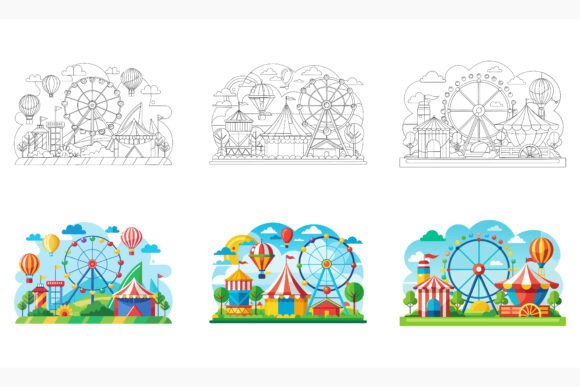
Before discussing strategy, it’s worth grounding the conversation in the practical contents of the package. The collection features three carefully composed variations of the street food market theme, each designed to give you flexibility without overwhelming you with redundancy. The deliverables include AI and EPS file formats, which remain the gold standard for scalable vector work, as well as high-resolution JPG previews for quick placement and reference.
One detail that often goes underappreciated is the file architecture. A poorly organized vector file can waste more time than it saves. This set is built with neatly organized layers and file structures, so locating individual elements, applying brand colors, or isolating a vendor stall for reuse becomes a straightforward task rather than a scavenger hunt. Here’s what the technical side offers:
- 3 distinct variations – providing thematic consistency with enough visual difference to support A/B testing or multi-channel campaigns.
- AI, EPS, and JPG formats – covering high-end print production, web graphics, and quick mockups.
- Cross-platform compatibility – designed for both Mac and Windows users without font or layer issues.
- Clean layer organization – making it practical to edit, recolor, and extract components quickly.
- Consistent level of detail – so that all elements share the same illustrative voice, which prevents jarring visual mismatches.
The ability to edit, change colors, and modify icons easily is not just a convenience; it’s a strategic necessity. Brand guidelines vary wildly, and a fixed palette illustration often clashes with existing materials. With well-structured EPS and AI files, you can remap every color to your palette in minutes, ensuring the street food market scene feels native to your brand rather than something tacked on.
Where Festive Market Visuals Create Real Strategic Value
The Fair Festive on Street Food Market theme taps into universally recognized cultural motifs—community, craftsmanship, warmth, and celebration. That emotional resonance isn’t accidental. When you place these illustrations into a presentation deck, a website hero section, or a printed flyer, you borrow that emotional tone and transfer it to your message. But the real strategic value appears when you match the asset to a clear business or communication goal.
Enriching Content Marketing and Social Media Narratives
Blog posts, newsletters, and social posts about local events, food entrepreneurship, seasonal promotions, or community building benefit enormously from custom-feeling visuals. Instead of relying on generic stock photos that audiences have become desensitized to, you can deploy an editable illustration that tells a story within your brand style. For example, a food delivery app could adapt one variation to promote a weekend market partnership by recoloring banners to match their app’s identity and inserting their logo subtly on a stall. This creates a coherent piece of content that feels designed rather than assembled.
Building a Cohesive Visual Brand Without an In-House Illustrator
Small businesses and solo marketers rarely have the budget for custom illustration on demand. A well-organized vector set like this acts as a semi-custom asset library. Because you can modify colors, remove elements, and repurpose individual icons, the same street food scene can be broken into smaller components: a food cart icon for a mobile app, a banner string for a website divider, a vendor silhouette for an infographic icon. This reuse multiplies the investment return and builds visual consistency across touchpoints—something that directly impacts brand recognition and trust over time.
Strengthening Presentations, Proposals, and Pitch Decks
Decision-makers often underestimate the role of visuals in internal and external presentations. A slide filled with bullet points rarely inspires. By weaving the festive market graphic into a proposal for a new event sponsorship, a community revitalization project, or a product launch tied to food culture, you inject a narrative layer that statistics alone can’t convey. Because the illustration is fully editable, you can adjust its complexity—simplifying it for titles or adding subtle animations in a PDF deck. The Mac and Windows compatibility ensures that team members on different operating systems won’t encounter broken layers or missing fonts, keeping collaboration smooth.
Planning Before You Download: Goals, Context, and Adaptation
Even the most beautifully crafted illustration set underperforms when used without forethought. The Fair Festive on Street Food Market files are not a magic solution; they are a raw material. Strategic use starts with three planning questions:
- What specific outcome do I need from this graphic? Clarify whether the goal is to increase click-through on a social ad, to clarify a complex concept in an infographic, or to create a mood for a landing page. The answer determines scale, color intensity, and placement.
- Where will this asset live, and for how long? A print flyer demands high-resolution JPGs or EPS output, while a web banner may need simplified layers for faster loading. Consider the lifespan too—seasonal campaigns might use the full festive theme; evergreen content might require a neutral recolor that avoids any dated elements.
- What level of customization is truly needed? Over-editing can waste time and dilute the professional finish. Identify the minimal changes required to align with your brand (e.g., adjusting two accent colors and removing one object) and resist the urge to completely redesign a file that already works.
Integrating Illustrations Into Your Existing Design Workflow
For users familiar with Adobe Illustrator or similar vector tools, the learning curve is negligible. However, even if you primarily work with Canva or other simplified platforms, the included JPGs allow immediate use, while the EPS/AI files can be opened by a freelancer for quick customizations. The key is to treat these assets as part of a larger design system. Maintain a master folder with untouched originals, and create copies for each project where you log your edits. This habit prevents version chaos and ensures you can always return to the base artwork.
Avoiding the Trap of Generic Atmosphere
A common mistake when using thematic illustration sets is letting the aesthetic dictate the message rather than the other way around. A vibrant street food market scene can inadvertently signal “local event” even when your content is about global supply chains or financial services. If the context isn’t aligned, the visual becomes dissonant, weakening credibility.
Before committing, ask whether the festive, community-oriented tone genuinely serves your narrative. If your brand voice is more corporate and subdued, you might use the illustration in a secondary role—perhaps a small accent on a thank-you page for a company that supports food-related charities, or a background element at 20% opacity for a report cover. Editing the color palette toward cooler, less saturated tones can also shift the emotional weight. The flexibility is there, but it requires a conscious design eye.
Another risk involves visual overload. The set’s rich detail is an asset, but in contexts where minimalism is expected (such as a modern tech onboarding flow), a fully populated market scene may distract. The solution is to extract individual elements—a single food stall, a string of lights, a steaming pot—and use them sparingly. This modular approach leverages the organized layer structure noted earlier and keeps the design focused.
Long-Term Value and Reuse Across Channels
Strategic buyers evaluate creative assets not just for a single project but for their multiplier potential. Because these files are suitable for print, web, symbols, apps, and infographics, the initial purchase cost gets amortized across multiple uses. You might begin with a social media campaign, then realize the same style works perfectly for merchandise tags at a farmers’ market booth, then adapt the icons for an email signature banner or an event invitation. Each reuse reinforces your visual identity.
Additionally, the fact that the design is built with consistency and attention to detail means you are less likely to run into technical issues like misaligned nodes or messy clipping masks that plague cheaper vector sets. For professionals who bill by the hour or manage tight deadlines, this reliability translates directly into saved billable time and fewer production delays.
When Might This Set Fall Short?
No single asset collection fits every need. If your primary use case demands photorealistic imagery, an illustration set won’t serve. If your brand aesthetic is strictly minimalist and monochromatic, you’ll need to invest significant editing time to strip away the festive character—and at that point, a simpler set might be wiser. Similarly, if you require animations or interactive elements intended for web apps, you’ll need to assess whether the supplied vector files can be easily adapted to SVG animation workflows. Always evaluate the cross-section of your technical capabilities and the file specifications before purchasing.
Making the Decision That Serves Your Work, Not Just Your Folder
It’s tempting to collect attractive design resources. Many creatives and marketers have folders full of assets they’ve never used. The Fair Festive on Street Food Market AI EPS illustration set is best approached with a specific intent: you have a project, campaign, or brand presence that would genuinely benefit from a warm, market-themed visual narrative, and you value the ability to customize that narrative without starting from scratch.
If you recognize that gap—perhaps a recurring need for food-culture visuals across blog posts, event materials, and client presentations—this collection solves a real operational problem. It collapses the time between concept and publication, it aligns with professional standards for cross-platform use, and it gives you enough creative control to avoid looking like every other brand using the same stock asset. The invitation to “buy now and start using this awesome illustration” becomes a business decision, not an impulse buy, when you’ve mapped the asset to your workflow and your audience’s expectations.
Approach it like any other strategic investment: clarify the role it will play, test one project with it, and then scale your usage based on results. With organized layers, editable colors, and three thoughtful variations, you have the raw materials to produce work that looks commissioned rather than downloaded. That perception shift—from generic to intentional—can make a measurable difference in engagement, trust, and the overall professionalism of your visual communications.