Bathroom Sink Unit Line Icon Set for Streamlined Visual Projects
When a design project calls for clear, purposeful imagery, the smallest graphical elements often carry the most weight. The Bathroom Sink Unit Line Icon Set enters the conversation as a focused collection of vector icons built around a single theme—sink units and related bathroom fixtures. Instead of wading through massive, unfocused icon libraries, professionals can pull exactly what they need from a compact, well-structured set. This article explores what the package actually contains, how it performs in daily work, and where it fits into a designer’s toolkit without overselling its scope.
What the Set Actually Includes
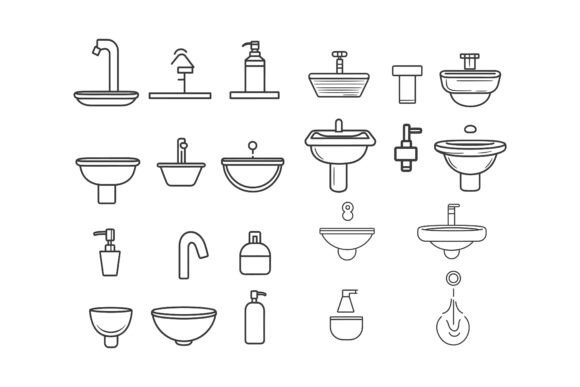
At its core, the Bathroom Sink Unit Line Icon Set is a bundle of line-style illustrations depicting various sink configurations, vanity outlines, and complementary bathroom elements. The collection comes in multiple file formats: native Adobe Illustrator (AI), Encapsulated PostScript (EPS), and a high-resolution JPG preview. This trio covers most professional workflows, from deep vector editing to quick raster placement. The line icons maintain a consistent stroke weight and simplified geometry, which makes them readable at small sizes and crisp when scaled up for larger displays.
Rather than a random assortment, the icons are grouped logically. You might find single-basin sinks, double basins, pedestal designs, wall-mounted units, and undercounter variations, each rendered with enough detail to be recognizable but without unnecessary complexity. That restraint is exactly why many professionals reach for a specialist set: it does one thing cleanly rather than trying to serve every possible symbol need at once.
Cross-Platform Compatibility and File Integrity
The package explicitly supports both Mac and Windows environments, which is more than a bullet point in a spec sheet—it means the EPS and AI files were likely saved with compatibility settings that prevent font substitution errors or layer corruption when opened on different operating systems. In practice, designers who jump between a MacBook in the studio and a Windows workstation at home will appreciate not having to rebuild paths or re-link missing assets.
The inclusion of a JPG reference image is a small but helpful touch. It gives you an at-a-glance view of all icons without launching a vector application, which speeds up asset selection when you are assembling mood boards or client presentations. The vector formats remain the real workhorses, however. EPS remains a universal exchange format for older publishing pipelines, while AI files preserve editable paths, layers, and any grouping the creator established.
Organized File and Layer Structure
One underrated quality in icon sets is internal organization. The Bathroom Sink Unit Line Icon Set boasts a neatly arranged file and layer structure. In practical terms, this means you won't open an AI file only to find hundreds of unnamed paths scattered across a single layer. Instead, each icon sits on its own labeled layer or within a clearly named group. This design decision saves real minutes during production. When you need to isolate a specific sink variant for an app button, you simply expand the layer panel, locate the descriptive name, and drag it into your master document.
Well-structured files also reduce errors. If you accidentally move an anchor point, the isolated layer prevents collateral damage to other icons. For teams that share assets across multiple projects, this organization becomes a quiet reliability factor. Junior designers or contractors can navigate the file without a steep learning curve, and senior leads can trust that extracting assets won't introduce unintended changes.
Detail Consistency and Visual Cohesion
Line icon sets live or die by uniformity. In the Bathroom Sink Unit Line Icon Set, every icon appears to follow the same grid, stroke width, and corner treatment. This perfection in detail means you can place a pedestal sink next to a wall-mounted unit on the same interface screen, and they will look like parts of the same family rather than mismatched clip art. Consistency extends to the level of simplification: curves are smooth, angles are deliberate, and negative space is balanced so no single icon feels heavier than the others.
For UI designers building a bathroom planner app or an interior design configurator, that visual harmony is non-negotiable. Inconsistent icons erode user trust and make the interface feel amateurish. Here, the creator's attention to detail pays off in a polished end product. Even in print contexts—such as a renovation catalog or a plumbing supply brochure—the cohesive look reinforces brand professionalism without extra tweaking.
Editing Freedom: Color, Size, and Modification
One of the strongest selling points of any vector illustration set is editability, and this collection emphasizes how easily you can change colors and modify each icon. Because the line art is built with simple strokes and basic shapes, applying a new stroke color takes a single click in Illustrator or similar software. Need filled versions instead of outlines? You can expand the strokes and use the pathfinder tools to create solid silhouettes. Want to adjust the tap design or add a soap dispenser? The paths are unflattened and editable at the anchor level.
This flexibility means the Bathroom Sink Unit Line Icon Set is not locked into a single aesthetic. A designer working on a luxury bathroom brand can recolor the icons in gold or matte black, while a facilities management dashboard might use bright status colors. Since the icons are resolution-independent vectors, you can blow them up for trade show banners or shrink them down for smartwatch companion apps without losing clarity. The ability to freely modify the source material extends its lifespan far beyond a one-off purchase.
Real-World Use Cases Across Media Types
The set is marketed as suitable for print, web, symbols, apps, and infographics, and that range holds up under scrutiny. In print, vector icons integrate smoothly into InDesign layouts for flyers, manuals, or product spec sheets. Because they are pure line art, they reproduce cleanly on uncoated paper and maintain readability even when printed in black-and-white. In web and app projects, the icons work as SVGs—you can export them from the AI or EPS files with standard tools, then style them with CSS or inline them as code.
For infographics, the bathroom sink icons serve as intuitive pictograms to break down statistics about water usage, renovation trends, or household demographics. An infographic comparing sink types becomes instantly clearer when each data point is accompanied by a relevant, consistent icon. Similarly, digital interfaces—such as smart home control panels or hotel booking platforms—can use the icons as part of a wayfinding system. Because the set focuses narrowly on sinks, it combines well with broader icon kits that cover lighting, heating, or plumbing general categories. You aren't forced to adopt an entire ecosystem; the sink icons fill a specific gap.
Who Gains the Most from This Collection
The audience for the Bathroom Sink Unit Line Icon Set isn't limited to a single profession. Interior design bloggers can use the icons to illustrate DIY guides or product comparisons. E-commerce store owners selling bathroom fixtures can integrate them into filter menus or product category icons. App developers building renovation estimators or bathroom planners get a ready-made symbol set that users recognize immediately. Educators preparing training materials for plumbing apprentices can label and annotate the icons to highlight different installation types.
Marketing professionals and content creators working with home improvement brands will find the icons useful for social media posts, email headers, and downloadable checklists. Because the style is neutral and professional, it doesn't clash with corporate branding guidelines. Small business owners who handle their own graphic design in tools like Canva or Affinity Designer can import the EPS files and resize them without the pixelation that plagues stock PNGs. Even serious hobbyists planning their own home renovation can use the icons to sketch layout options before committing to expensive changes.
Practical Observations and Possible Limitations
No design resource is perfect for every scenario, and it's worth noting where this set sits best. The collection is deliberately narrow, which is both its strength and its boundary. If your project requires isometric bathroom renders, photorealistic 3D models, or heavily decorative vintage illustrations, this line icon set won't replace those assets. It lives in the flat, minimal, vector world—ideal for modern UI and clean informational graphics, less so for moody editorial spreads.
Another consideration is color customization depth. While changing stroke colors is trivial, the icons don't come with pre-made filled, duotone, or gradient variations. You will need to spend a few minutes in a vector editor if you want something other than the default outlined style. This isn't a flaw; it's a trade-off that prioritizes lightweight, editable source files over bloated export options. Professionals will likely appreciate the lean approach, but beginners may need to learn basic Illustrator or Inkscape skills to get full value.
Because the files are built around AI and EPS formats, those working exclusively in raster-based software like Photoshop or Procreate will face an extra conversion step. The included JPG gives immediate access, but the true power lies in the vector originals. If your workflow is 100% raster, consider whether you will make use of the editable layers and scalable paths.
Long-Term Value and Reusability
One measure of a useful icon set is how often you return to it across projects. The Bathroom Sink Unit Line Icon Set benefits from being evergreen. Sink designs don't change radically from year to year; the icons you use in a 2024 mobile app will still look appropriate in 2029. Since the files are editable, you can sustain them yourself—tweaking line weights if design trends shift toward bolder strokes, or adjusting corner radii to match evolving brand guidelines. There's no subscription fee, no cloud dependency, and no expiration date on the assets.
For agencies that build multiple client projects in the home services or real estate sectors, the set becomes a reusable library component. Once you've tailored the icons to your agency's preferred style, you can drop them into pitch decks, wireframes, and final deliverables without relicensing. That kind of asset efficiency matters when margins are tight and timelines are short.
Integrating the Icons into an Existing Workflow
Adopting a new icon set should feel frictionless. With the Bathroom Sink Unit Line Icon Set, the recommended approach is to open the AI master file, inspect the layers, and copy only the icons you actually need into a new document. This preserves the original as an untouched source. From there, you can create an asset library in your design tool of choice. In Figma, Sketch, or Adobe XD, the icons convert to components that can be reused throughout a prototype. In PowerPoint or Keynote, the EMF or SVG exports become clean diagram elements. The organized starting point reduces the busywork of searching, renaming, and recoloring that often eats into creative time.
For developers, exporting selected icons as SVG code opens the door to inline styling and animation. A simple hover state on a sink icon—changing the water droplet color, for example—adds a layer of interactivity without requiring a custom illustration from scratch. Because the paths are clean and minimal, the SVG code remains lightweight, contributing to faster page loads and a smoother user experience.
The Bathroom Sink Unit Line Icon Set earns its place in a professional toolkit by doing exactly what it promises: providing a focused, editable, and consistent group of line art illustrations around a specific theme. The combination of AI, EPS, and JPG formats, cross-platform reliability, and logical layer organization makes it a practical pick for anyone who regularly needs bathroom-related icons. Rather than chasing every possible style or subject, the set respects its niche and executes it with care. For designers, marketers, developers, and educators working in home improvement, real estate, or product visualization, it offers immediate utility and long-term flexibility without unnecessary complexity.