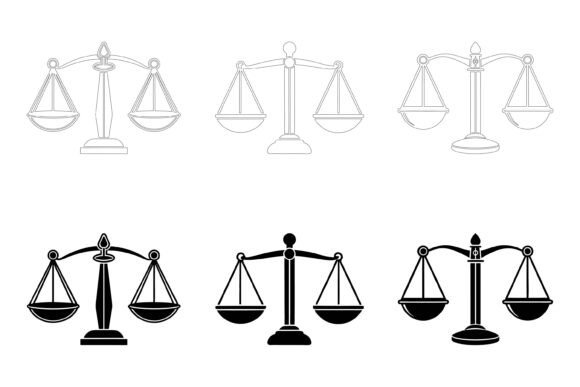
Why Law Scales Illustrations Matter Across Every Project
Legal imagery carries a weight that few other symbols can match. The balanced scales, the poised figure of justice, the architectural gravity of courtrooms—these visuals communicate fairness, authority, and resolution without needing a single word of explanation. When someone searches for law scales illustrations, they are rarely just looking for a picture. They need a visual anchor that lends credibility to a message, simplifies a complex concept, or reinforces trust in a brand or educational piece.
What often gets overlooked is how differently people approach the same set of vector files. A freelance web designer opening an AI EPS collection has an entirely different checklist than a small business owner preparing a printed contract template, and both differ from an educator building a classroom presentation on civic rights. Understanding those differences is what turns a generic download into something genuinely useful.
What Law Scales Illustrations Actually Offer
At its core, a law scales illustration set provides professionally designed graphics centered on legal themes—balanced scales, gavels, courthouses, justice figures, and related symbolic elements. The format matters enormously. AI EPS files are vector-based, which means they scale infinitely without losing crispness. A JPG preview gives a quick reference, but the real flexibility lives in the editable vectors. These illustrations ship with organized file and layer structures, so you can isolate individual elements, recolor them, adjust proportions, or combine them with other graphics without fighting through a tangled mess of unnamed layers.
For Mac and Windows users alike, compatibility headaches disappear because the file formats are universal across major design applications like Adobe Illustrator, Affinity Designer, CorelDRAW, and even free alternatives such as Inkscape. The collection is built with detail consistency in mind—line weights stay uniform, styling remains coherent across icons, and every symbol reads clearly whether it sits at 32 pixels on a mobile app button or stretches across a full-width print banner.
When Speed and Simplicity Matter Most
For a small business owner who needs to update a terms-of-service page or prepare a professional-looking invoice template, diving deep into vector editing is probably not the goal. They want something that works right away. The included JPG files serve that need immediately—drag and drop into a Word document, a Canva layout, or a simple webpage, and the visual is already doing its job. The organized structure means that even if they later hand the files to a designer for customization, the groundwork is solid and confusion-free.
Beginners and hobbyists often share this priority. Someone creating materials for a local community group, a mock trial club, or a personal blog about legal rights may never have opened an EPS file before. The first moments of that experience shape whether they feel empowered or overwhelmed. A neatly organized file with clearly labeled layers can shorten the learning curve dramatically. When every element is easy to locate and modify, the software itself becomes less intimidating.
Creative Control for Designers and Developers
Experienced creatives evaluate illustration sets through a different lens. They look at how easily colors can be swapped to match brand palettes, whether icons maintain visual consistency when placed side by side, and how cleanly paths are constructed for further editing. Law-themed graphics often find their way into app interfaces—legal directory apps, contract management tools, compliance dashboards—where pixel-level precision is non-negotiable. An icon that looks fine at 200 pixels might reveal awkward curves or inconsistent stroke widths when examined up close. The emphasis on perfection in details and consistency speaks directly to this audience.
Web designers building law firm websites or legal resource platforms also need variety within a coherent style. A single set that includes scales, gavels, columns, and justice figures—all sharing the same visual language—removes the friction of patching together icons from disparate sources. The ability to edit, recolor, and modify each element independently means a developer can create hover states, active states, and alternate color schemes without hunting for supplementary files.
Commercial Value for Marketers and Entrepreneurs
Marketing professionals and entrepreneurs often think about visuals in terms of conversion and trust signals. A landing page for a mediation service, a financial compliance tool, or even a tax preparation app benefits from imagery that quietly reinforces integrity. Law scales do that heavy lifting subconsciously. When a visitor sees balanced, professionally rendered legal icons, the underlying message is stability and fairness—qualities that directly influence decision-making.
For those producing infographics, the editable nature of vector files becomes essential. Data about court case outcomes, statistical breakdowns of legal processes, or flowcharts explaining rights and procedures all need icons that can be sized, colored, and arranged without degradation. Print use adds another layer: a brochure designed for offset printing demands high-resolution output, and vector files deliver that without the pixelation risks that haunt raster images.
Practical Ways Different People Put These Files to Work
Consider a freelance educator building an online course about constitutional law. They need slides that feel authoritative but not stuffy. Pulling a law scales icon from this collection, adjusting its color to match the course branding, and placing it consistently across slide decks creates visual continuity that students register without consciously noticing. The same instructor might use a simplified version of the icon as a progress marker within the learning management system, scaling it down without losing legibility.
A publisher preparing a handbook on tenant rights might use the gavel and scales graphics to visually separate sections, signal important callouts, or anchor the cover design. Because the files are editable, the publisher can mute the colors to match a subdued, serious tone or brighten them for a more accessible, community-oriented feel—the same core artwork adapts to totally different emotional registers.
Software developers face yet another scenario. An app that helps users track legal deadlines may incorporate scale icons into navigation menus, notification badges, and onboarding screens. Consistency across these touchpoints matters because users subconsciously associate visual coherence with reliability. A mismatched icon set—where one symbol has thick strokes and another is delicately thin—unsettles that impression. Cohesive, detail-oriented design files prevent that problem before it starts.
How to Decide if This Type of Illustration Set Fits Your Needs
Start by identifying what kind of editing you realistically expect to do. If you need full creative control—changing colors, isolating individual symbols, or embedding graphics into a larger design system—the AI EPS format is what you should be looking for. The ability to modify icons easily according to specific needs saves money and time compared to commissioning custom illustrations or buying multiple single-use assets.
Next, think about where the graphics will live. Print projects benefit from the resolution independence of vectors. Digital projects—websites, apps, social media graphics, email newsletters—also rely on clean scaling, especially with the variety of screen sizes and pixel densities in use today. An illustration that works equally well in all those environments has genuine long-term usefulness.
Also consider whether the style aligns with the tone you want to project. Legal imagery can easily veer into cold, impersonal territory. Look for collections where the line work and proportions feel balanced and approachable without sacrificing seriousness. That sweet spot is what makes the visuals appropriate for a consumer-facing app as well as an internal corporate training module.
Beginners often find a practical shortcut here: open the JPG preview first, use it as a reference, and only dive into the EPS when customization becomes necessary. That graduated approach reduces initial friction while preserving full capability for later. Professionals, by contrast, may jump straight into the layered files and start adapting immediately—both paths are valid, and good file organization supports both equally.
Small Details That Change the Experience
Cross-platform compatibility between Mac and Windows environments saves troubleshooting headaches in collaborative projects. When a designer on a Mac sends files to a client on Windows, or when a team uses a mix of operating systems, format issues can derail timelines. AI EPS files bridge that gap cleanly.
Layer organization is another quiet feature that only becomes visible when it is absent. Anyone who has spent an hour clicking through unnamed paths to find the one element they need will appreciate a file structure where every piece is logically grouped and labeled. This matters for infographic creators who need to extract and rearrange components rapidly, and it matters for educators who want to pull a single symbol into a presentation without affecting the rest of the set.
Ultimately, law scales illustrations serve a function far beyond decoration. They frame messages, anchor user interfaces, support learning materials, and reinforce brand identities—all while operating almost invisibly in the background of someone's attention. Choosing a set that delivers on detail, editability, and cross-use flexibility means the visuals stay useful as projects evolve, rather than becoming something to replace at the next redesign.
The difference between a frustrating asset and a reliable one often comes down to the thoughtfulness built into the files themselves—consistent styling, clear structure, and editing paths that feel intuitive rather than obstructive. For print and web, for symbols and infographics, for beginners finding their way and professionals pushing pixels with precision, those qualities determine whether an illustration set becomes a go-to resource or a one-time download.