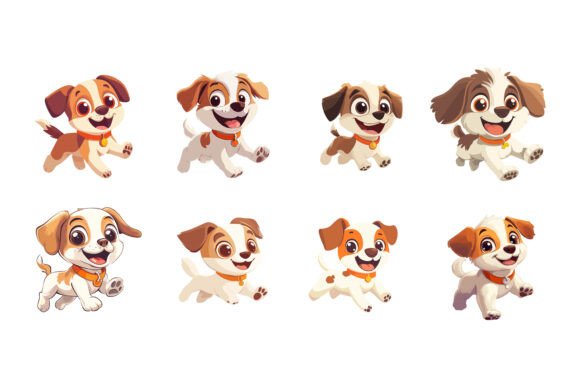
The Playful Puppy Illustration Collection: Understanding AI EPS Vector Art and Its Creative Potential
Vector illustration sets have become essential resources for designers, educators, and business owners who need flexible, high-quality graphics that adapt across multiple platforms. When you encounter a collection built around a Playful Puppy theme, you are looking at more than just cute dog drawings — you are accessing a carefully constructed design asset engineered for versatility and professional output. Understanding what sets certain AI EPS illustration collections apart helps you make informed decisions about which resources will genuinely serve your creative projects.
What Makes AI EPS Format the Gold Standard for Vector Illustrations
Before diving into the specific charm of a puppy-themed collection, it is worth examining why the file formats themselves carry so much weight in professional design circles. AI stands for Adobe Illustrator, the native file format of one of the most widely used vector graphic editors in the world. EPS, or Encapsulated PostScript, serves as a universal vector exchange format that maintains fidelity across different software environments. When an illustration set includes both AI and EPS files alongside JPG previews, you gain a complete toolkit that covers editing, sharing, and quick reference needs.
The inclusion of JPG files might seem secondary, but these raster previews serve an important organizational purpose. They allow you to browse through the collection quickly without opening each vector file individually. For designers managing dozens or hundreds of assets, this simple addition saves considerable time during the selection phase of a project.
Cross-Platform Compatibility for Mac and Windows Users
One detail that often gets overlooked until it becomes a frustrating roadblock is operating system compatibility. A vector collection designed for both Mac and Windows users eliminates the friction that arises when file structures or naming conventions cater to only one platform. This dual compatibility signals that the creators have considered diverse workflows and development environments. Whether you work on a MacBook in a design studio or operate a Windows machine in a corporate marketing department, the files open correctly and maintain their layer integrity.
The Emotional and Commercial Appeal of a Playful Puppy Theme
Dogs, particularly puppies, occupy a unique space in visual communication. They convey warmth, trust, energy, and approachability without needing words. A Playful Puppy illustration can soften a brand identity, add personality to educational materials, or create instant emotional connection in social media content. Unlike abstract geometric designs that require cognitive interpretation, puppy imagery triggers an immediate, universally understood positive response.
This emotional accessibility makes puppy-themed vector sets valuable across surprisingly diverse sectors. Veterinary clinics use them for branding and patient education. Pet supply companies integrate them into packaging and advertising. Children's book illustrators adapt the elements for storytelling. Even tech companies occasionally leverage animal mascots to humanize their products — and a Playful Puppy fills that role naturally without the complexity of developing a custom character from scratch.
Versatility Across Industries and Applications
The range of professionals who benefit from a well-organized puppy illustration set extends far beyond what you might initially assume. Consider the following spectrum of use cases:
- Educators and content creators who need engaging visuals for worksheets, presentations, and digital learning modules
- Small business owners in pet-related industries looking to build cohesive branding without commissioning custom illustration work
- Web designers seeking lightweight, scalable icons and decorative elements that load quickly and look crisp on retina displays
- Print designers working on brochures, flyers, greeting cards, or merchandise where resolution independence is non-negotiable
- App developers who require symbols and interface elements that can be recolored and resized programmatically
- Hobbyists and crafters using cutting machines, printable designs, or personal projects that demand editable vector paths
Each of these user groups interacts with the same core asset in fundamentally different ways, which highlights why flexibility in the source files matters so much.
Organizational Excellence as a Marker of Professional Quality
One of the most telling indicators of a premium illustration collection is not the artwork itself — though that certainly matters — but rather the organizational structure behind it. When files arrive neatly organized with logical naming conventions and clean layer structures, you spend less time deciphering the asset and more time deploying it. This is especially critical in team environments where multiple people access the same resource library. A designer who inherits a project midway should be able to open a file and immediately understand how it is constructed.
Layer Structure and Editability
The mention of a neatly organized layer structure deserves deeper attention. In vector illustration, layers separate different visual components so that a designer can isolate, modify, or remove elements without disturbing the rest of the artwork. A well-constructed Playful Puppy illustration might place the dog's body on one layer, facial features on another, accessories like collars or toys on additional layers, and background elements on yet another. This separation empowers you to recolor the puppy's fur while keeping the eyes and nose unchanged, or to extract just the bone toy for use as a standalone icon.
Changing colors and modifying icons easily is often promised but not always delivered. True editability means the vector paths are clean — no unnecessary anchor points, no raster images embedded where vectors should be, and no locked or flattened layers that resist modification. When these conditions are met, a designer can adapt the artwork to match any brand palette or stylistic requirement in minutes rather than hours.
Perfection in Details and Consistency Across the Set
Consistency functions as a quiet quality signal that separates thoughtfully produced illustration sets from hastily assembled clip art bundles. In a Playful Puppy collection, consistency might manifest through uniform line weights, cohesive color palettes, matching illustration styles across different poses or scenarios, and proportional harmony between elements. When you place two illustrations from the same set side by side, they should feel like they belong to the same visual family.
Attention to detail reveals itself in subtler ways. The curvature of a puppy's ear, the sparkle in an eye, the natural positioning of paws — these nuances determine whether the illustration reads as generic clip art or as carefully crafted design content. For professionals whose reputation depends on the quality of their visual output, this distinction carries significant weight.
Why Detail Precision Matters for Print and Digital Output
Print applications demand higher standards than digital displays. What looks acceptable on a screen at 72 pixels per inch can reveal flaws when printed at 300 dots per inch on a large-format banner or packaging material. Vector illustrations inherently avoid pixelation issues, but they can still suffer from poorly constructed curves or awkward intersections between shapes. A collection that emphasizes perfection in details has likely been reviewed at high magnification to ensure every bezier curve resolves cleanly.
For digital applications, including websites, mobile apps, and infographics, the same precision ensures that the illustrations maintain their integrity when scaled down to favicon size or expanded to fill a hero banner. The scalability of vectors is only as valuable as the craftsmanship of the underlying paths.
Practical Integration into Design Workflows
Understanding how a Playful Puppy illustration set fits into real design workflows clarifies its practical value. Imagine you are developing an infographic about pet adoption statistics. You need icons representing dogs, homes, hearts, and data points. With an editable vector set, you can extract relevant elements, unify their colors to match the infographic's palette, resize them without quality loss, and arrange them cohesively. The entire process might take under an hour, whereas illustrating each element from scratch could consume a full workday.
In web design, these illustrations can serve as engaging visual anchors for landing pages, blog post headers, or call-to-action sections. Because they are vectors, you can export them as SVGs — a format that remains crisp on any screen resolution while maintaining a small file size that supports fast page loading. This technical advantage directly influences user experience and search engine performance metrics.
Modification Scenarios That Demonstrate Flexibility
To illustrate the practical significance of editability, consider several common modification scenarios. A pet groomer wants to use a puppy illustration in their logo but needs the fur color to match a specific breed associated with their business. With editable vector layers, they select the fur shapes and apply a new fill color in seconds. A veterinary clinic preparing a brochure about dental care needs to highlight a puppy's mouth area — they can isolate that element, enlarge it, and add annotation lines without distorting surrounding artwork. A children's app developer requires the same puppy character in multiple emotional states; they can modify facial expressions independently because the features sit on dedicated layers.
Each scenario depends on the combination of clean vector construction and thoughtful layer organization that distinguishes professionally built illustration sets from flat, uneditable alternatives.
Suitability Across Media Types
The versatility of a well-made AI EPS illustration collection becomes most apparent when you examine its performance across different media types. Print materials like business cards, brochures, posters, and merchandise require CMYK color space compatibility and high-resolution output — both of which vector formats handle natively. Web applications benefit from the ability to export at any resolution and in modern formats like SVG. Symbols and icons derived from the illustrations can populate app interfaces, wayfinding systems, or data visualizations. Infographics combine multiple extracted elements to tell visual stories that engage audiences and improve information retention.
This cross-media adaptability means that a single investment in a quality illustration set can serve an organization's needs across marketing, product development, educational content, and internal communications. Rather than sourcing different assets for each channel, creative teams can maintain visual consistency by drawing from a unified collection.
Evaluating Illustration Sets Through an Informed Lens
When you encounter an AI EPS illustration collection — whether it features a Playful Puppy or any other thematic focus — several evaluation criteria can guide your assessment. Look beyond the preview images and investigate the file structure. Are layers named meaningfully or left as generic defaults? Do the vector paths appear clean when viewed in outline mode? Are the colors defined in consistent swatches that facilitate global changes? These technical details predict how smoothly the assets will integrate into your existing workflows.
Also consider the range of content within the set. A collection that offers multiple poses, expressions, accessories, and contextual elements provides more creative flexibility than one built around a single composition. The ability to mix and match components multiplies the potential applications without requiring additional purchases or external resources.
The decision to use a particular illustration set ultimately balances artistic quality, technical construction, licensing terms, and practical editability. By understanding what each of these dimensions entails, you position yourself to choose resources that genuinely enhance your creative output rather than creating additional work through poor organization or limited flexibility. A thoughtfully developed Playful Puppy collection exemplifies how thematic charm and professional-grade construction can coexist in a single, versatile design asset.